
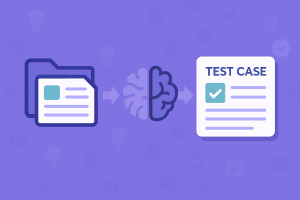

In large enterprises, test case generation is rarely a simple task. It’s not the lack of tools that slows teams down it’s the weeks of analysis, consulting, and SME knowledge transfer required just to understand the context before testing can even begin.
Solution designs live across folders, documents, diagrams, specifications, and process hierarchies. Translating all of that into testable requirements often means:
Delays between design completion and actual validation. By the time test cases are ready, the reality has already changed. This is the gap Vansah’s Contextual AI Intelligence is designed to eliminate.
- Lengthy analysis and discovery phases
- Heavy reliance on expensive subject matter experts
- Manual interpretation of L1 to L5 process hierarchies
From Documentation Overload to Instant Context
Test generation tools operate on surface-level inputs text fields, isolated requirements, or manually curated user stories. That approach simply doesn’t work for complex enterprise environments. Vansah’s Contextual AI Intelligence takes a fundamentally different approach:
The moment you connect your design artifacts, the analysis is already done.
Instead of waiting weeks for human experts to translate documentation, Vansah instantly contextualizes your entire solution landscape turning rich, enterprise-grade documentation into actionable enterprise quality test cases without a consulting phase.
This isn’t faster analysis it’s quality intelligence applied upfront, eliminating analysis as a delivery bottleneck.
What “Instant Contextualization” Really Means
Rather than walking you through a long technical setup, let’s focus on the outcome that matters most to enterprise teams:
- Built-in transparency and auditability Every test case is generated from traceable inputs hierarchy context, requirements, and authoritative documentation making intent, coverage, and decisions fully visible and defensible for audits.
- Consistent quality aligned to enterprise governance Test cases adhere to organizational standards, terminology, and control frameworks, ensuring quality is applied uniformly across teams, programs, and regulatory boundaries.
- End-to-end requirement traceability by design Each test case is automatically linked to its authoritative requirement sources, preserving context, intent, and evidence without manual reconciliation.
- Dramatically reduced reliance on SME knowledge transfer By extracting and structuring knowledge directly from validated documents, Vansah eliminates up to 90% of manual SME handoffs while preserving institutional knowledge.
- Accelerated, repeatable test design at scale AI-driven generation grounded in real context reduces test design effort by up to 95%, enabling faster delivery without sacrificing accuracy, compliance, or control
The result: Test generation starts immediately, replacing weeks of workshops and manual interpretation with audit-ready test designs built for enterprise compliance.
The Outcome: Testing That Reflects Reality Now
With Contextual AI Intelligence, enterprises move directly to validation.
- Tests are grounded in real solution designs from day one not weeks after manual interpretation or consulting cycles.
- Teams validate faster while maintaining full governance and compliance.
- Quality engineering shifts from reactive defect detection to proactive assurance.
- Test design effort is reduced by up to 95%, accelerating delivery without compromising control.
How It Works

Vansah’s contextual intelligence works by assembling a complete “evidence set” for every generated test then using it as the governing context for test cases and scripts.
First, it deeply analyzes your folder hierarchy (L1 -> L5), pulling in the descriptions and intent at each level so tests reflect the right business domain, process, and scope. Next, it incorporates project-level strategy and objectives, including your custom prompts, so the output follows your organizational standards, terminology, and testing expectations.
It then brings linked user stories and requirements into the same review structure, ensuring each test is traceable and derived from validated requirement intent not isolated issue fields.
Finally, Vansah extends beyond traditional AI by applying AI-enabled attachment intelligence: when attachments are enabled, it generates detailed summaries from authoritative documents (solution designs, specs, process docs) and uses those insights to ground every test case and test script in real business rules, real workflows, and real operational context resulting in more accurate, enterprise-ready Test coverage.
Transformative Outcomes
From Surface-Level to True Quality Engineering

Tests Reflect Reality
With Vansah’s contextual intelligence, test cases are no longer based on assumptions, incomplete requirements, or abstract scenarios. Instead, they are generated from the same documentation, business rules, and workflows that govern your production systems.
By incorporating hierarchy context, validated requirements, and authoritative attachments such as solution designs and process documents, Vansah ensures tests mirror real system behavior, integrations, and edge cases.

Business Rules Validated
Vansah ensures critical business logic is validated systematically by deriving tests directly from authoritative sources such as requirements, solution designs, and process documentation.
Instead of relying on assumptions or manual interpretation, AI-generated test cases reflect the actual rules, conditions, and decision paths that drive system behavior.

Process Alignment
Vansah generates test cases that are natively aligned with enterprise processes, terminology, and governance standards by grounding every test in project context, organizational structure, and authoritative documentation.
By understanding how your business defines workflows, controls, and outcomes, Vansah ensures tests follow the same language, conventions, and process logic used across delivery and operations.
This capability helps teams move from surface-level automation to true quality engineering, where tests are driven by deep context, not isolated text fields.
Next Steps: Schedule a Personalized Demo
Ready to see what test generation looks like when it’s driven by real context not assumptions?
Move beyond surface-level automation and start building tests that reflect how your business truly operates.
See How Vansah Eliminates Analysis and Consulting Phases
The fastest way to understand Vansah’s impact is through a personalized enterprise demo tailored to your environment. Experience what testing looks like when context is instant and governance is built in.