

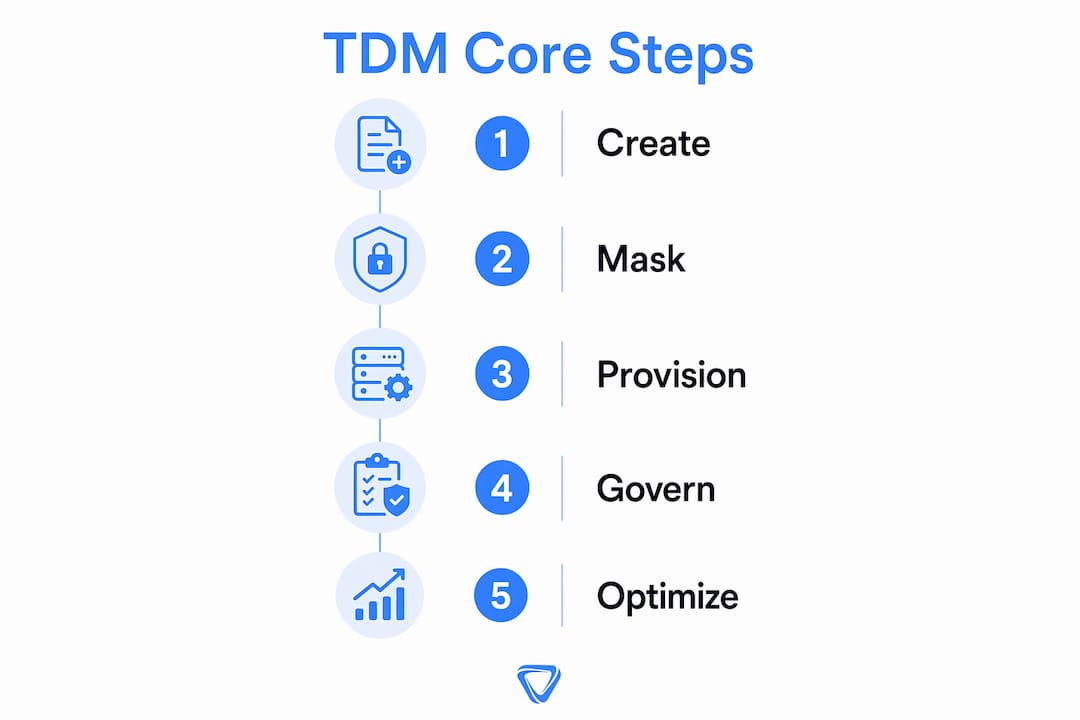
Test data management (TDM) is the practice of creating, securing, provisioning, and maintaining datasets used in software testing to ensure quality, compliance, and speed throughout the development lifecycle. Without a deliberate TDM strategy, teams run tests against incomplete, stale, or sensitive data, producing unreliable results and real compliance exposure. Regulations like GDPR, HIPAA, and CPRA make this risk concrete. Platforms like K2view TDM, Delphix, and Informatica have built entire product lines around solving it. This guide breaks down what effective TDM looks like in 2026, from masking pipelines to governance frameworks, so your team can test faster and stay compliant.
What are the core components of test data management?
Test data management ensures the right data, in the right state, is available on demand while maintaining compliance with data protection requirements. That definition sounds simple. The execution is not. Effective TDM combines several distinct practices that work together across the test data lifecycle.
The foundational components every team needs to address:
- Data provisioning and subsetting: Extracting a representative slice of production data for non-production environments, rather than copying the full database. This reduces storage costs and speeds up environment setup.
- Data masking and anonymization: Replacing sensitive fields like Social Security numbers, email addresses, and payment card data with realistic but fictitious values before data reaches test environments.
- Synthetic test data generation: Creating artificial datasets from scratch when production data is unavailable, insufficient, or too sensitive to use even after masking.
- Version control and rollback: Maintaining snapshots of test datasets so teams can reset to a known state between test runs without manual intervention.
- Automation and CI/CD integration: Connecting TDM pipelines to tools like Jenkins, GitHub Actions, or Azure DevOps so data provisioning happens automatically as part of the build process.
Pro Tip: Combining synthetic data for edge cases with masked subsets of real production data gives you both speed and realism. Neither approach alone covers every testing scenario.
Combining synthetic data with masked real data subsets maximizes test coverage and compliance simultaneously. Teams that rely on a single approach consistently hit gaps, either in data realism or in regulatory coverage.

How do data masking and privacy regulations intersect in TDM?
Data masking is the process of transforming sensitive fields in a dataset so the result is realistic and functional but contains no identifiable information. It is the primary mechanism teams use to meet GDPR, HIPAA, CPRA, and PCI-DSS requirements in non-production environments. Getting masking wrong does not just create flaky tests. It creates audit failures and regulatory fines.
The best masking implementations follow these steps:
- Classify sensitive data first. Without accurate classification of sensitive fields, masking requirements are guesswork. Discovery is the foundation of every compliant TDM program.
- Apply deterministic masking. Deterministic masking ensures the same input always produces the same masked output, preserving foreign key relationships and referential integrity across tables.
- Preserve format and utility. A masked email address should still look like an email address. A masked ZIP code should still pass format validation. Masked data that breaks application logic defeats the purpose of testing.
- Automate and schedule masking pipelines. Masking pipelines must run automatically on schedule or on demand, with built-in validation that no exact sensitive data matches remain after transformation.
- Document everything for audit readiness. SOC 2 and GDPR audits require evidence that masking ran, what rules applied, and when. Audit trails are not optional.
“Validation of masking includes verifying no exact sensitive data matches remain, ensuring referential integrity is intact, and confirming masked data formats remain valid post-transformation.” — totalshiftleft.ai
A common pitfall is treating masking as a one-time setup task. Production data changes constantly. New sensitive fields get added. Masking pipelines need regular review and re-validation to stay effective and compliant.
What technologies and tools optimize test data provisioning?
The tools teams use for test data provisioning have matured significantly. Three categories now dominate: database virtualization engines, self-service provisioning portals, and AI-powered masking and generation platforms.
Database virtualization is the most impactful technology for teams managing large, complex environments. Broadcom’s DAVE (Database Automation and Virtualization Engine) delivers independent, storage-efficient test data clones in minutes using delta-storage. Each tester gets an isolated environment without duplicating the full dataset. This eliminates data contention between parallel test runs and dramatically reduces storage overhead.
Self-service provisioning through portals and APIs lets developers and testers request fresh data clones without waiting for DBA support. That shift alone removes one of the most common bottlenecks in QA workflows. Choice Hotels cut database refresh times by 90% using Delphix virtualization and automation. That is not a marginal improvement. It changes how teams plan sprints.
| Tool | Key capability | Best for |
|---|---|---|
| K2view TDM | Entity-based data provisioning and masking | Complex relational data models |
| Delphix | Virtualization and automated data delivery | Large-scale DevOps environments |
| Informatica | Enterprise data masking and discovery | Regulated industries with broad data estates |
| Broadcom DAVE | Delta-storage cloning and self-service portals | Teams needing fast, isolated test environments |
Pro Tip: When evaluating TDM tools, prioritize CI/CD integration depth over feature count. A tool that fits cleanly into your existing pipeline delivers more value than one with more features that requires manual handoffs.
Virtualization with delta-storage and independent clones also stabilizes testing outcomes by isolating data changes between test runs. This directly reduces test flakiness caused by shared data state, which is one of the most frustrating and least visible sources of unreliable QA results.
How can teams govern test data for security and auditability?
Test data governance is the set of policies, controls, and workflows that ensure test data is handled consistently, securely, and in a way that can be demonstrated to auditors. Without governance, TDM becomes a collection of ad hoc scripts that nobody fully understands and nobody can audit.
Effective governance programs share these characteristics:
- Sensitive data classification and cataloging: Every field that could contain PII, PHI, or financial data is identified, tagged, and tracked. This catalog drives masking rules and access controls automatically.
- Version-controlled configurations: Version-controlled TDM configurations enable repeatable, auditable workflows that support SOC 2 and other compliance audits by tracking what masking and provisioning steps ran, when, and why.
- Automated provisioning with controlled retention: Data environments are created and destroyed automatically. Stale test environments with unmasked or outdated data do not accumulate.
- Role-based access controls: Testers get access to the environments they need. They do not get access to production data or to environments owned by other teams.
- Audit trails for every operation: Every masking run, every provisioning event, and every data destruction action is logged with timestamps and rule references. This is what SOC 2 compliance auditors actually look for.
Realistic test data not only increases release quality but also reduces rework caused by flaky tests driven by poor masking or incomplete datasets. Governance is what keeps that data realistic, consistent, and compliant over time. Teams that treat governance as a compliance checkbox miss its operational value entirely.
Key takeaways
Effective test data management requires combining masking, synthetic generation, virtualization, and governance into a single automated pipeline that integrates directly with your CI/CD workflow.
| Point | Details |
|---|---|
| Define TDM scope early | Identify all sensitive fields before building masking or provisioning workflows. |
| Use deterministic masking | Consistent masked outputs preserve referential integrity and prevent test failures. |
| Automate provisioning | Self-service cloning removes DBA bottlenecks and accelerates QA cycle times. |
| Embed governance controls | Version-controlled configs and audit trails are required for SOC 2 and GDPR audits. |
| Combine data strategies | Pair synthetic data for edge cases with masked production subsets for realistic coverage. |
Our take on scaling TDM in real organizations
The teams that struggle most with TDM are the ones that treat it as a data problem rather than a workflow problem. They invest in masking tools but leave provisioning manual. They build synthetic data generators but skip governance. The result is a patchwork that works until it does not, usually right before a release.
What actually works is building TDM as a pipeline, not a toolbox. Automation and repeatability matter more than any individual feature. When masking runs on a schedule, provisioning happens through an API, and every action is logged, compliance stops being a scramble before an audit and starts being a byproduct of normal operations.
The referential integrity challenge is real and underestimated. Deterministic masking across related tables is harder than it looks, especially in legacy systems with undocumented foreign keys. Teams that skip this step end up with masked data that breaks application logic, which produces false test failures and erodes trust in the entire QA process.
Compliance, done right, actually expands data access. When teams can demonstrate that non-production environments are properly masked and governed, security and legal teams become more willing to approve broader data sharing for testing. That is the counterintuitive payoff of investing in TDM governance. You get more data to test with, not less.
For teams using Jira, pairing a solid TDM pipeline with AI-powered test data management tools closes the loop between data availability and test execution quality.
— Vansah
Manage test data and test cases in one place with Vansah
Vansah Test Management for Jira connects your test data strategy directly to your test execution workflow. Running natively inside Jira, Vansah lets teams execute tests against real Jira issues, track results in real time, and maintain full traceability from requirement to test outcome. Vansah Intelligence, the platform’s generative AI capability, analyzes Jira stories and generates structured test cases in seconds, reducing the manual effort that slows QA teams down. For teams embedding TDM into continuous testing pipelines, Vansah integrates with Playwright, Selenium, Postman, and major CI/CD tools. Explore the Vansah test management roadmap to see how the platform supports scalable, compliant QA workflows in 2026.
FAQ
What is test data management in software testing?
Test data management is the process of creating, provisioning, masking, and governing datasets used in software testing to ensure accuracy, compliance, and repeatability. It covers the full lifecycle from data sourcing through environment cleanup.
Why is data masking required in test environments?
Regulations like GDPR, HIPAA, and PCI-DSS prohibit using real personal or financial data in non-production environments without proper controls. Masking replaces sensitive fields with realistic fictitious values so testing can proceed without compliance risk.
What is the difference between synthetic data and masked data?
Synthetic data is generated from scratch with no connection to real records, making it ideal for edge cases and load testing. Masked data is derived from real production records with sensitive fields transformed, preserving realistic data relationships and application behavior.
How does test data governance support SOC 2 audits?
SOC 2 audits require evidence that sensitive data is handled consistently and securely across non-production environments. Version-controlled masking configurations, automated provisioning logs, and documented data destruction records provide the audit trail auditors need.
How does database virtualization improve test data provisioning?
Database virtualization tools like Broadcom DAVE and Delphix deliver isolated test environment clones in minutes using delta-storage, eliminating the need to copy full databases. This reduces provisioning time, storage costs, and data contention between parallel test runs.
Recommended
- Modernising Testing for the Digital Age | Vansah Test Management For Jira
- Top software testing strategies for enterprise releases | Vansah Test Management For Jira
- Introducing AI-Powered Test Data Management | Vansah Test Management For Jira
- Introducing Vansah’s Context-Aware Test Data Management | Vansah Test Management For Jira