

Enterprise software delivery has entered a new phase.
AI is no longer experimental. It is embedded in tools, workflows, and platforms across the delivery lifecycle. Yet for many CIOs and Heads of Quality, one uncomfortable reality remains: AI-generated testing intelligence often cannot be trusted at enterprise scale.
Not because AI lacks capability but because it lacks context. This is the gap Vansah’s Contextual AI was designed to solve.
The Problem with Today’s AI-Driven Testing
Most AI-powered testing tools today follow a similar pattern:
- Take a user story, document, or prompt
- Apply language-based reasoning
- Generate test cases, insights, or recommendations
On the surface, this appears powerful. In practice, it introduces risk. Enterprise requirements are rarely self-contained. They live within:
- Multi-level programs and portfolios
- Layered business domains
- Regulatory and compliance frameworks
- Historical decisions and constraints
- Linked artefacts, attachments, and work items
When AI operates on isolated inputs, it produces outputs that may look correct but are often:
- Incomplete
- Contextually misaligned
- Difficult to justify
- Impossible to audit
This is why many enterprise leaders remain cautious. AI that cannot explain why it produced an outcome or what context it considered cannot be relied upon for critical testing decisions.
Enterprise Testing Doesn’t Start with Prompts
It Starts with Understanding Context
Vansah takes a fundamentally different approach.
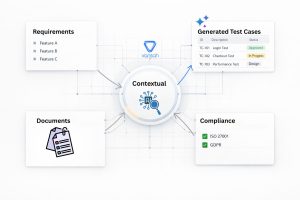
Instead of treating AI as a prompt-response engine, Vansah treats AI as an intelligence layer, one that must first understand the full requirement environment before reasoning or generation begins.
This philosophy is embedded directly into Vansah’s Contextual AI enterprise solution design. The core principle is simple but powerful:
- Context is assembled first.
- Intelligence is applied second.
- Generation comes last.
This shift is what makes Vansah’s approach enterprise-grade.
How It Works

Folder-Centric Context Intelligence
Vansah treats the folder as the true unit of intent not just individual issues.
Each folder layer contributes:
- Folder name
- Descriptions
- Work items
- Attachments
This mirrors how real enterprise requirements are organized, not how AI prefers to consume text.

Multi-Level Context Packets (L0–L5)
The system assembles context incrementally:
- L0 (Leaf Folder)
Where test cases are generated — but not in isolation. - L1–L5 (Parent Context Layers)
Each level contributes upstream intent:- Program goals
- Business domain constraints
- Service-level context
- Regulatory or operational framing
These are packaged into structured context packets before any AI reasoning occurs.
Why This Is Superior to Prompt-Based AI
Vansah doesn’t ask: “What test cases can I generate?” It asks: “Do I fully understand everything this requirement sits within before generating anything?”
As enterprises move past AI experimentation, the focus is shifting to:
- Trust
- Governance
- Accuracy
- Accountability
Vansah’s Contextual AI design is built for this phase not hype, but operational intelligence.
Next Steps: Schedule a Personalized Demo
AI that doesn’t understand context cannot be trusted in enterprise testing.
Vansah’s Contextual AI doesn’t guess it understands.